
How to Keep Your Pets Safe Around the Christmas Tree
Learn how to cat-proof and dog-proof your Christmas tree with simple, practical tips. Keep your pets safe and enjoy a stress-free holiday season.
By:
The Good Home Daily
Posted on December 22, 2025
The Christmas season is finally around the corner. And just like last year, pet owners have to face another holiday challenge: keeping their pets away from the Christmas tree.
With its twinkling lights, hanging ornaments, and interesting new smells, a Christmas tree is almost impossible for curious pets to ignore. That is why, for fur parents, pet-proofing the holiday setup is a mandatory yearly task.
Because if you don’t, you know exactly what happens: the moment you finish decorating, your dog is already tugging at the lights or your cat is plotting its first climb. The struggle is like
So to keep your holiday stress-free, we’ll help you dog-proof and cat-proof your Christmas tree. Let’s protect your tree from your pets—and also protect your pets from their own curiosity.
4 Reasons Why Pets Are Drawn to Christmas Trees

Understanding why pets are drawn to Christmas trees makes it easier to prevent problems before they start. Once you know what triggers their curiosity, you can design your setup to work with their instincts, not against them.
1. The Novelty Effect and Instinctual Curiosity
Domestic animals, particularly dogs and cats, are highly sensitive to changes in their environment. In animal behavior science, this is often linked to Neophilia—an attraction to new objects.
Research on intrinsic motivation shows that novelty strongly attracts animal attention. Bringing a new object like a tree into a familiar space introduces a novel stimulus that naturally invites investigation.
Pets may investigate or interact with holiday decorations simply because they are new and interesting, especially when those items resemble playthings or chewable curiosities.
2. Height-Seeking Behavior
Cats climb Christmas trees because vertical space appeals to their natural instincts and behavioral needs. As both predators and prey, cats are evolutionarily wired to seek high vantage points.
A Christmas tree offers a tall, climbable structure where cats can observe their environment, monitor activity, and feel safe from perceived threats.
Climbing the tree also satisfies their desire for personal space and control over territory. High places give cats a sense of dominance and security, allowing them to establish a preferred position in their home, especially in multi-cat households.
3. Olfactory Overload
Beyond sight, trees also stimulate pets through smell. Real trees give off a distinct pine scent that many pets find intriguing, while artificial trees may carry residual packaging odors that invite sniffing and exploration.
These novel scents can trigger natural marking instincts in some pets, which is why a few dogs or cats may feel compelled to “claim” the tree.
4. Christmas Tree Ornaments Resemble Prey and Toys
The dangling ornaments and glittering decorations on a tree often behave visually like moving or reflective objects—similar to natural prey that gets a cat’s attention. Lights that twinkle or shimmer can further attract a cat’s gaze and trigger predatory play behavior.
How to Cat-Proof Your Christmas Tree
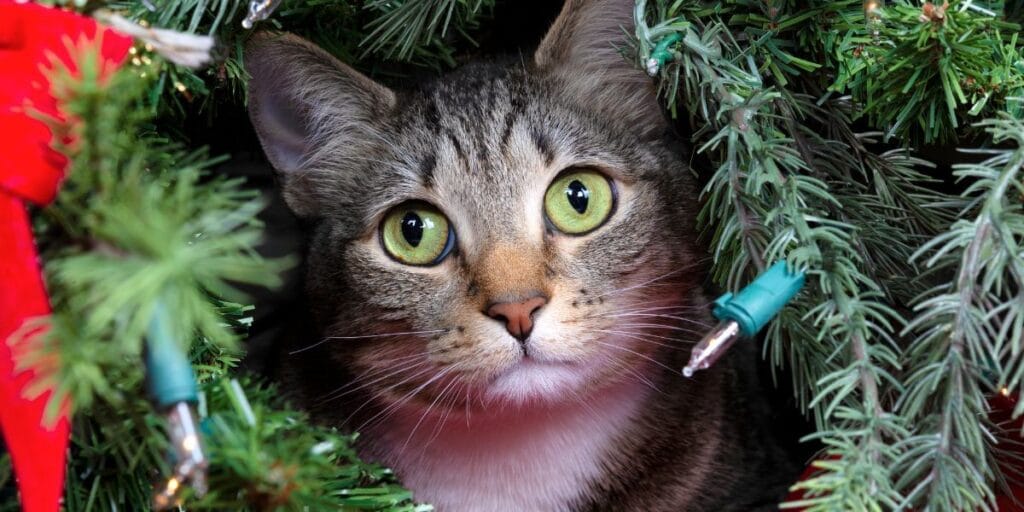
Cats are drawn to Christmas trees for very specific reasons: height, movement, shine, and unpredictability. When you understand these triggers, creating a cat-proof Christmas tree becomes less about stopping behavior and more about removing the cues that invite it.
Here are the most effective tips to keep your cat from climbing the Christmas tree this season.
1. Start by Seeing the Tree the Way Your Cat Does
Before changing anything, stand at your cat’s eye level, roughly 8 to 12 inches off the floor, and observe the tree for a full minute. Look for movement: swaying branches, blinking lights, rotating ornaments, or tinsel shifting with air flow.
Most climbing attempts are triggered within the 2 to 5 foot vertical zone, where motion is easiest to see and reach. Prioritizing this area immediately reduces temptation.
2. Limit Climbing Opportunities
Cats love height and exploring vertical spaces. Place your tree away from furniture or shelves that could be used as launch points. Anchoring the tree with a sturdy stand or wall brackets ensures it stays upright even if your cat reaches the lower branches.
3. Reduce Motion Where It Matters Most
Cats respond strongly to movement that feels unpredictable. This is why dangling ornaments and flickering lights attract them more than static decorations.
Focus on eliminating motion rather than decoration entirely. Secure lightweight ornaments using museum putty, slip silicone tubing over ornament hooks to limit sway, and avoid loose tinsel ends. Even small movements, once dampened, can significantly lower a cat’s interest.
This directly addresses the prey-like movement that triggers chasing and climbing behavior.
4. Control Air Flow and Hidden Triggers
Subtle air movement can make a tree far more exciting than it appears. Drafts from vents, pet doors, or ceiling fans can cause branches or decorations to sway just enough to invite play.
To neutralize this trigger, position the tree away from direct air currents or adjust vent louvers to direct airflow elsewhere. Eliminating these micro-movements reduces the tree’s “visual noise,” allowing it to blend into the background rather than acting as an active lure.
5. Use Cat-Safe Deterrents
There are cat-safe deterrents that can discourage climbing, such as citrus scents. Avoid anything harmful, like sprays with essential oils that are toxic to cats. This method supports pets and Christmas tree safety without stressing your cat.
6. Choose Steady Lights and Avoid Rapid Flicker
Blinking lights can unintentionally trigger cats’ pursuit responses. As mentioned, rapid light changes can mimic prey movement.
If possible, choose steady warm white lights. If twinkling is important, use strings with slower pulse intervals. Longer gaps between changes feel less stimulating and reduce chase behavior.
7. Redirect Your Cat’s Play Away From the Tree
As mentioned, cats seek movement, not just the tree itself. Redirecting that instinct works better than constant correction.
Place a low shelf or cat tree 3 to 4 feet away from the tree and stock it with toys that offer controlled, predictable motion. Motion-activated toys or interactive play sessions timed before dusk help satisfy hunting instincts without turning the tree into a target.
How to Dog-Proof Your Christmas Tree
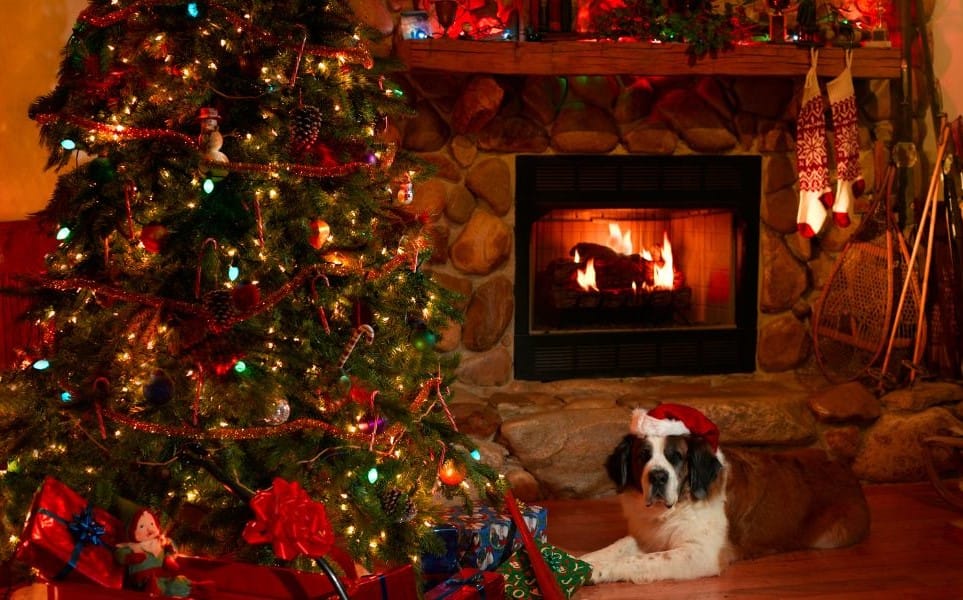
Dogs experience Christmas trees differently from cats. Instead of climbing, most dogs are drawn to new smells, chewable textures, dangling objects, and movement at nose level. Here are a few strategies to dog-proof your Christmas tree:
1. Secure the Tree and Surroundings Against Accidental Bumps
Dogs can unintentionally knock over a Christmas tree simply by wagging their tail, brushing past, or playing nearby. Securing the tree with a heavy, sturdy base is essential to prevent tipping.
For added stability, you can anchor the tree to a nearby wall or ceiling hook, which keeps it upright even if a dog bumps into it.
2. Remove Low Ornaments
Keep fragile and tempting ornaments out of your dog’s reach. Hang breakable or chewable items higher up on the tree, ideally above nose level.
This simple step removes primary triggers for investigation. Dogs are less likely to paw or chew when there’s nothing at their height to grab. It also protects both the decorations and your pet from accidents.
3. Hide or Cover Electrical Cords Completely
Chewing is one of the biggest holiday risks for dogs. Exposed light cords can look like toys and smell unfamiliar, making them especially tempting.
Use cord covers, run wires behind furniture, or tape them securely along baseboards. Never leave loose cords accessible at floor level.
4. Skip Dangling Decorations
Tinsel, ribbons, or small dangling items can look like toys. Remove these entirely or place them well out of reach.
These decorations often trigger playful or chewing behavior. Eliminating them reduces the risk of ingestion and keeps dogs from seeing the tree as a play object.
5. Redirect With Toys
Provide chew toys, puzzle feeders, or other enrichment nearby. This gives dogs a safe and rewarding alternative to the tree.
Redirection satisfies their curiosity and hunting instincts. When the alternative is more engaging than the tree, dogs are less likely to cause trouble.
6. Restrict Access When Unsupervised
Sometimes the simplest solution is the most effective. When you cannot directly supervise your dog, consider using a dog gate or closing the door to the room with the tree. Limiting access entirely removes the opportunity for unwanted interaction.
7. Reward Calm Behavior
Praise or treat your dog for calm behavior around the tree. Positive reinforcement encourages repeated peaceful interactions.
Avoid punishment, which can increase stress or curiosity. Reinforcing calm behavior teaches your dog that the tree is not a play object.
Keep Your Pets Safe Around the Christmas Tree
A Christmas tree can bring warmth and joy to your home, but for curious pets, it’s a tempting new adventure. The goal is not just to prevent accidents—it’s to keep your pets safe around the Christmas tree while letting them enjoy the holiday season.
Observe their behavior, anticipate their curiosity, and make small adjustments when needed.
Remember, the holiday season is also a chance to reinforce positive habits. With patience and mindfulness, you can wrap up the season with festive cheer, knowing everyone stays happy and safe.